With the sun setting earlier, and the threat of new COVID lockdowns, there is a real threat of a depression, seasonal and isolation. A partial remedy is exercise; it helps fight depression whether you take other measures not. An article published last month in the Journal of Affective Disorders reviewed 22 studies of the efficacy of exercise, particularly as an add-on to drugs and therapy. Almost every study showed that exercise helped, and in some studies it helped a lot. See table below. All of the authors are from the University of British Columbia. You can read the article here.
From “Efficacy of exercise combined with standard treatment for depression compared to standard treatment alone: A systematic review and meta-analysis of randomized controlled trials.” by JacquelineLee1 et al.In virtually every study, exercise helps fight depression.
For those who are willing to exercise, there are benefits aside from mental health. Even a daily walk around the block helps with bone strength, weight control, heart disease, plus the above mentioned improvement in mood. More exercise does more. If you bicycle without a helmet, you’re likely to live longer than if you drive.
For those who can’t stand exercise, or if exercise isn’t quite enough to send away the blues, you can try therapy, medication, and/or diet. There is some evidence that food that are high in lithium help fight depression. These food include nuts, beans, tomatoes, some mineral waters, e.g. from Lithia springs, GA. The does is about 1/100 the dose given as a bipolar treatment, but there is evidence that even such small doses help. Lithium was one of the seven ingredients in seven up — it was the one that was supposed to cheer you up. See some research here.
Most people have heard of Moor’s law, the law that computing power keeps doubling every two years, with the price remaining the same, but the same law is observed with other tech products, notably lithium ion batteries and solar cells.
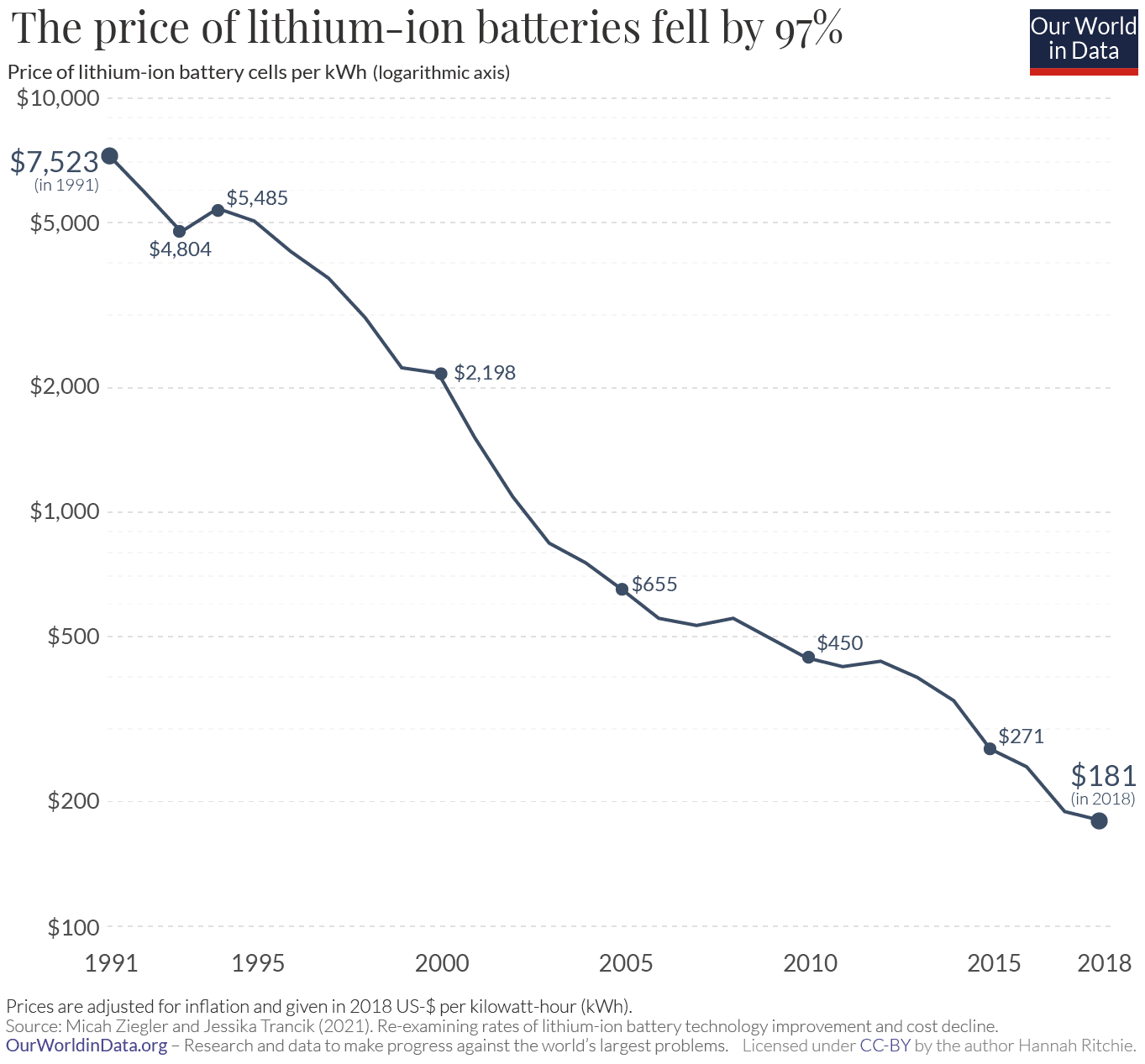
By my calculation the price of lithium ion batteries has fallen 98% so far, at a rate of 12.5% per year. That’s a remarkable drop given that the chemistry has hardly changed. The size has dropped too; it’s nowhere near as much as the price but enough to make batteries a reasonable choice for powering automobiles, scooters, and power tools. Batteries still lack the range and fast charging for some applications, but even there the low cost means that hybrids become attractive, combining for cars and truck, the long range of gas with a reduced cost per mile. The rate of decrease suggests that prices will be below $100 per kWh by 2025. That’s an $8000 cost for a battery powered car with 300 miles of range.
As for where the electricity comes from, the price of electricity is going up and becoming less reliable. In part that’s because of regulations on coal and nuclear power and the inherent problems with large-scale wind and solar. But decentralized solar may turn out to be a winner. Solar prices have fallen 99.6% since 1976. Even though the rate of decrease is slower, about an 8% drop in price per year, there is a sense that solar power has entered the mainstream. Combined with cheap, home batteries, it may soon make sense to power your home and car by solar cells on the house; there isn’t enough area on a car to quite power it.
It’s been a while since I did an assessment of hydrogen and batteries for automobile propulsion, and while some basics have not changed, the price and durability of batteries has improved, the price of gasoline has doubled, and the first commercial fuel cell cars have appeared in the USA. The net result (see details below) is that I find the cost of ownership for a gasoline and a battery car is now about the same, depending on usage and location, and that hydrogen, while still more pricey, is close to being a practical option.
EV Chargers. They look so much cooler than gasoline hoses, and the price per mile is about the same.
Lithium battery costs are now about $150/kwh. That’s $10,000 for a 70 kWh battery. That’s about 1/5 the price of a Tesla Model 3. The reliability that Tesla claims is 200,000 miles or more, but that’s with slow charging. For mostly fast charging, Car and Driver’s expectation is 120,000 miles. That’s just about the average life-span of a car these days.
The cost of the battery and possible replacement adds to the cost of the vehicle, but electricity is far cheaper than gasoline, per mile. The price of gasoline has doubled to, currently, $3.50 per gallon. A typical car will get about 24 mpg, and that means a current operation cost of 14.6¢/mile. That’s about $1,460/year for someone who drives 10,000 miles per year. I’ll add about $150 for oil and filter changes, and figure that operating a gas-powered car engine costs about $1,610 per year.
If you charge at home, your electricity costs, on average, 14¢/kWh. This is a bargain compared to gasoline since electricity is made from coal and nuclear, mostly, and is subsidized while gasoline is taxed. At level 2 charging stations, where most people charge, electricity costs about 50¢/kWh. This is three times the cost of home electricity, but it still translates to only about $32 for a fill-up that take 3 hours. According to “Inside EVs”, in moderate temperatures, a Tesla Model 3 uses 14.59 kWh/100 km with range-efficient driving. This translates to 11.7¢ per mile, or $1170/year, assuming 10,000 miles of moderate temperature driving. If you live in moderate climates: Californian, Texas or Florida, an electric car is cheaper to operate than a gasoline car. In cold weather gasoline power still makes sense since a battery-electric car uses battery power for heat, while a gasoline powered car uses waste heat from the engine.
Battery cars are still somewhat of more expensive than the equivalent gasoline car, but not that much. In a sense you can add $400/year for the extra cost of the Tesla above, but that just raises the effective operating cost to about $1,570/year, about the same as for the gasoline car. On the other hand, many folks drive less than 50 miles per day and can charge at home each night. This saves most of the electric cost. In sum, I find that EVs have hit a tipping point, and Tesla lead the way.
Now to consider hydrogen. When most people think hydrogen, they think H2 fuel, and a PEM fuel cell car. The problem here is that hydrogen is expensive, and PEM FCs aren’t particularly efficient. Hydrogen costs about $10/kg at a typical fueling station and, with PEM, that 1 kg of hydrogen takes you only about 25 miles. The net result is that the combination hydrogen + PEM results in a driving cost of about 40¢/mile, or about three times the price of gasoline. But Toyota has proposed two better options. The fist is a PEM hybrid, the hydrogen Prius. It’s for the commuter who drives less than about 40 miles per day. It has a 10kWh battery, far cheaper than the Tesla above, but enough for the daily commute. He or she would use charge at home at night, and use hydrogen fuel only when going on longer trips. If there are few long trips, you come out way ahead.
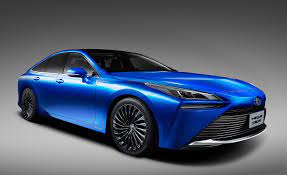
Toyota 2021 Mirai, hydrogen powered vehicle
Toyota also claims to have a hydrogen powered Corolla or debut in 2023. This car will have a standard engine, and I would expect (hope) will drive also — preferably — on hythane, a mix of hydrogen and methane. Hythane is much cheaper per volume, and more energy dense, see my analysis. While Toyota has not said that their Corolla would run on hythane, it is supposed to have an internal combustion engine, and that suggests that hythane will work in it.
A more advanced option for Toyota or any other car/truck manufacturer would be to design to use solid oxide fuel cells, SOFCs, either with hydrogen or hythane. SOFCs are significantly more efficient than PEM, and they are capable of burning hythane, and to some extent natural gas too. Hythane is not particularly available, but it could be. Any station that currently sells natural gas could sell hythane. As for delivery to the station, natural gas lines already exist underground, and the station would just blend in hydrogen, produced at the station by electrolysis, or delivered. Hythane can also be made locally from sewer gas methane, and wind-power hydrogen. Yet another SOFC option is to start with natural gas and convert some of the natural gas to hydrogen on-board using left-over heat from the SOFC. I’ve a patent for this process.
Speaking of supply network, I should mention the brown outs we’ve been having in Detroit. Electric cars are part of the stress to the electric grid, but I believe that, with intelligent charging (and discharging) the concern is more than manageable. The driver who goes 10,000 miles per year only adds about 2,350 kWh/year of extra electric demand. This is a small fraction of the demand of a typical home, 12,154 kWh/year.It’s manageable. Then again, hythane adds no demand to the electric grid and the charge time is quicker — virtually instantaneous.
It is a fundamental of science that that the properties of every pure one-phase material is totally fixed properties at any given temperature and pressure. Thus for example, water at 0°C is accepted to always have a density of 0.998 gm/cc, a vapor pressure of 17.5 Torr, a viscosity of 1.002 centipoise (milliPascal seconds) and a speed of sound of 1481 m/s. Set the temperature and pressure of any other material and every other quality is set. But things go screwy near surfaces, and this is particularly true for water where the hydrogen bond — a quantum bond — predominates.
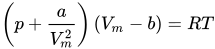
its vapor pressure rises and it becomes less inclined to condense or freeze. I use this odd aspect of thermodynamics to keep my platinum-based hydrogen getter catalysis active at low temperatures where they would normally clog. Normal platinum catalysts are not suitable for hydrogen removal at normal temperatures, eg room temperature, because the water that forms from hydrogen oxidation chokes off the catalytic surface. Hydrophobic additions prevent this, and I’d like to show you why this works, and why other odd things happen, based on an approximation called the Van der Waals equation of state:
(1)
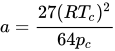
This equation described the molar volume of a pure material, , of any pure material based not the pressure, the absolute temperature (Kelvin) and two, substance-specific constants, and . These constants can be understood as an attraction force term, and a molecular volume respectively. It is common to calculate a and b from the critical temperature and pressure as follows, where Tc is absolute temperature:
, (2 a,b)
For water Tc = 647 K (374°C) and 220.5 bar. Plugging in these numbers, the Van der Waals gives reasonable values for the density of water both as a liquid and a gas, and thus gives a reasonable value for the boiling point.
Now consider the effect that an inert surface would have on the effective values of a and b near that surface. The volume of the molecules will not change, and thus b will not change, but the value of a will change, likely by about half. This is because, the number of molecules surrounding any other molecule is reduced by about half while the inert surface adds nothing to the attraction. Near a surface, surrounding molecules still attract each other the same as before, but there are about half as many molecules at any temperature and pressure.
To get a physical sense of what the surface does, consider using the new values of a and b to determine a new value for Tc and Pc, for materials near the surface. Since b does not change, we see that the presence of a surface does not affect the ratio of Tc and Pc, but it decreases the effective value of Tc — by about half. For water, that is a change from 647 K to 323.5K, 50.5°C, very close to room temperature. Pc changes to 110 bar, about 1600 psi. Since the new value of Tc is close to room temperature, the the density of water will be much lower near the surface, and the viscosity can be expected to drop. The net result is that water flows more readily through a teflon pipe than through an ordinary pipe, a difference that is particularly apparent at small diameters.
This decrease in effective Tc is useful for fire hoses, and for making sailing ships go faster (use teflon paint) and for making my hydrogen removal catalysts more active at low temperatures. Condensed water can block the pores to the catalyst; teflon can forestall this condensation. It’s a general trick of thermodynamics, reasonably useful. Now you know it, and now you know why it works.
I’m an enemy of unity and a harborer of prejudice. During the election, I was told that all Republicans are, and I’ve come to accept it as true. I’d run for county water commissioner (drain commissioner) as a Republican, see web-site, and the charge is fair. I wasn’t happy to that George Will write to not for any Republicans because, in his opinion, we’re all prejudiced, and thus a Democrat is better for all jobs. When George, or anyone else, talks about getting rid of the prejudiced, it sounds to me like he wants to get rid of me and those who think like me. We’re to be replaced by those who think like him, or (since he has few solid ideas) whose ideas are gleaned as an average of those running the respectable media (It turns out there are only a fairly few people running the respectable media).
Biden seems to have fallen into the presidency. He didn’t campaign, but the press and a lot of people didn’t like Trump, and could not settle on anyone with opinions.
I didn’t like how the Water department was run, or how the costs were distributed, and some of this has to do with prejudice — engineering aesthetics, I call it. After living with these prejudices or aesthetics, I’ve come to think of them as part of me. I worked to form my opinions — opinions of what was fair, and who was likely to do good work, and what was good engineering. My prejudices and opinions were developed over many years. They’re not perfect, but I like them. I don’t want to have to exchange my opinions and prejudices for the government’s. If I felt otherwise, I would not have run for office. I also resent sensitivity training — the person running them rarely shows any sensitivity, IMHO.
One of the things that anti-racists hate, and I support is zionism. It’s a founding principle of Black Lives Matter that black people in the US can’t be free so long as the zionist state (Israel) exists. Why is this? There is an assumption that all black peoples are one, and that zionists are oppressors. Not that you could tell a Palestinian from a zionist by skin color, but it’s a truth that the faculty of Princeton endorses.
Not long ago the faculty of Princeton University voted unanimously for BDS including a ban on any zionist speaker from speaking on campus. The faculty also picked George Will as the graduation speaker in 2020. Most of the professors chose to not vote, but of those who did (1/7 of the total including many Jews) the pro-BDS vote was unanimous. As a result, if Einstein were to rise from the grave, with the unified field equations finally worked out, he’d have to speak off-campus because he was a zionist, and the university is committed to BLM and anti prejudice. (Tell me again, how does anti-zionism help black lives to matter?; how does BLM help you get clean water or good sewage treatment?)
In terms of sewage treatment or bringing clean water, I’ve found that the sort of person willing to do the work is usually someone with an opinion, and that usually it’s a rough opinion. My sense is to let people have their opinions and to say, if you treat the sewage right, I treat you right. Good work isn’t cheap, and people who do it can’t be culled from those with the right views and political opinions.
While campaigning I told leaders of the pipe-fitters union that I could tell that the Pontiac sewage plant was badly run just by smelling the air around the plant — you shouldn’t be able to smell a sewage plant from miles away. They said that was a racist statement. I then told them that the boilers were rusty, and that at the roof of the digester cad caved in, at least a year ago. They said they’d already endorsed the Democrat, and only spoke to me as a courtesy.
Branson’s Virgin Space Ship (VSS) Unity was cheered as a revolutionary milestone today (July 10) after taking Branson, three friends and two pilots on a three minute ride to the edge of space, an altitude of 53.5 miles or 283,000 feet. I’d like to put that achievement into contest, both with previous space planes, like the Concorde and X-15 (the 1960s space plane), and also in context with the offerings of Elon Musk’s Space-X and Bezos’s, Blue Horizon.
To start with, the VSS Unity launched from a sub-sonic mother ship, as the X-15 had before it. This saves a lot in fuel weight and safety equipment, but it makes scale up problematic. In this case, the mother-ship was named Eve. Unity launched from Eve at 46,000 feet, about 9 miles up, and at Mach 0.5; it took Eve nearly 90 minutes to get to altitude and position. It was only after separation, that Unity began a one minute, 3 G rocket burn that brought it to its top speed, Mach 3, at about 16 miles up. What followed was a 3 minute, unpowered glide to 53.5 miles and down. Everyone seems to have enjoyed the three minutes of weightlessness, and it should be remembered that there is a lot of difference between Mach 3 and orbital speed, Mach 31. Also there is a lot of difference between a sub-orbital and orbital.
Concorde SST landing in Farnborough.
By comparison, consider the Concorde SSTs that first flew in 1976. It reached about 2/3 the speed of Unity, Mach 2.1, but carried 120 commercial passengers. It took off from the ground and maintained this speed for 4500 miles, going from London to Houston in 4.5 hours. While the Concorde only reached an altitude of 60,000 feet, it is far more impressive going at Mach 2.1 for 4.5 hours than going at Mach 3 for three minutes. And there is a lot of difference between 120 passengers and 4. There is also the advantage of taking off from the ground. A three minute ride in a space plane should not require a 90 minute ascent on a mother ship.
X-15 landing, 1962.
Next consider the X-15 rocket plane of the 1960s. This was a test platform devoted to engine and maneuverability tests; it turns out that maneuverability is very difficult. The X-15 hit a maximum altitude of 354,200 ft, 67 miles, and a maximum speed of Mach 6.72, or 4520 mph. That’s significantly higher than Branson’s VSS, and double the maximum speed. As an aside, the X-15 project involved the development of a new nickel alloy that I use today, Inconel X-750. I use this as a support for my hydrogen membranes. If any new materials were developed for VSS, none were mentioned.
The Air Force’s X-37B Orbital Test Vehicle at Kennedy Space Center, May 7, 2017.
Continuing with the history of NASA’s X-program, we move to the X-41, a air-breathing scramjet of the 1980s and 90s. It reached 95,000 feet, and a maximum speed of Mach 9.64. That’s about three times as fast as Virgin’s VSS. The current X-plane is called X-37B, it is a rocket-plane like the X-15 and VSS, but faster and maneuverable at high speed and altitude. It’s the heart of Trump’s new, US Space force. In several tests over the past 5 years, it has hit orbital speed, 17,426 mph, Mach 31, and orbital altitudes, about 100 miles, after being launched by a Atlas V or a Falcon 9 booster. The details are classified. Apparently it has maneuverability. While the X-37B is unmanned, a larger, manned version, is being built, the X-37C. It is supposed to carry as many as six.
Reaching orbital speed or Mach 31 implies roughly 100 times as much kinetic energy per mass as reaching the Mach 3.1 of Virgin’s VSS. In this sense, the space shuttle, and the current X-plane are 100 times more impressive than Virgin’s VSS. There is also a lot to be said for maneuverability and for a longer flight duration– more than a few minutes. Not that I require Branson to beat NASA’s current offerings, but I anyone claiming cutting edge genius and visionary status should at least beat NASA’s offerings of the 1960s, and the Concorde planes of 1976.
Bezos’s Blue Origin, and the New Shepard launcher.
And that bring’s us to the current batch of non-governmental, space cadets. Elon Musk stands out to me as a head above the rest, at least. Eight years ago, his Grasshopper rocket premiered the first practical, example of vertical take off and landing booster. Today, his Falcon 9 boosters send packages into earth orbit, and beyond, launching Israel’s moon project, as one example. That implies speeds of Mach 31 and higher, at least at the payload. It’s impressive, even compared to X-37, very impressive.
Bezos’ offering, the Blue Origin Shepherd, seems to me like a poor imitation of the SpaceX Falcon. Like Falcon, it’s a reusable, vertical takeoff and landing platform, that launches directly from earth, and like Falcon it carries a usable payload, but it only reaches speeds of Mach 3 and altitudes about 65 miles. Besides, the capsule lands by way of parachutes, not using wings like the space shuttle, or the X-37B, and there is no reusable booster like Falcon. Blue Origin started carrying payloads only in 2019, five yers after SpaceX. There is nothing here that’s cutting edge, IMHO, and I don’t imagine it will be cheaper either.
Branson has something that the other rocket men do not have, quite: a compelling look: personal marketing, a personal story, and a political slant that the press loves and I find hypocritical and hokey. The press, and our politicians, managed to present this flight as more than an energy wasting, joy ride for rich folks. Instead, this is accepted as Branson’s personal fight against climate change. Presented this way, it should qualify as a tax-dodge. I don’t see it getting folks to stop polluting and commit to small cars, but the press is impressed, or claims to be. The powers have committed themselves to this type of Tartuffe, and the press goes along. You’d think that, before giving Branson public adoration for his technology or environmentalism, he should have cutting technology and have been required to save energy, or pollute less. At least beat the specs of the X-15. Just my opinion.
It’s not uncommon for scientists to get inspiration from popular music. I’d already written about how the song ‘City of New Orleans’ inspires my view of the economics of trains, I’d now like to talk about dealing with nuclear waste, and how the song Alice’s Restaurant affects my outlook.
The best way to get rid of nuclear waste would be (as I’ve blogged) to use a fast nuclear reactor to turn the worst components into more energy and less-dangerous elements. Unfortunately doing this requires reprocessing, and reprocessing was banned by Jimmy Carter, one of my least favorite presidents. The alternative is to store the nuclear waste indefinitely, waiting for someone to come up with a solution, like allowing it to be buried in Yucca Mountain, the US burial site that was approved, but that Obama decided should not be used. What then? We have nuclear waste scattered around the country, waiting. I was brought in as part of a think-tank, to decide what to do with it, and came to agree with several others, and with Arlo Guthrie, that one big pile [of waste] Is better than two little piles. Even if we can’t bury it, it would be better to put the waste in fewer places (other countries bury their waste, BTW).
That was many years ago, but even the shipping of waste has been held up as being political. Part of the problem is that nuclear waste gives off hydrogen — the radiation knocks hydrogen atoms off of water, paper, etc. and you need to keep the hydrogen levels low to be able to transport the waste safely. As it turns out we are one a few companies that makes hydrogen removal pellets and catalysts. Our products have found customers running tourist submarines (lead batteries also give off hydrogen) and customers making sealed electronics, and we are waiting for the nuclear shipping industry to open up. In recent months, I’ve been working on improving our products so they work better at low temperature. Perhaps I’ll write about that later, but here’s where you’d go to buy our current products.
Robert Buxbaum, July 4, 2021. I’ve done a few hydrogen-related posts in a row now. In part that’s because I’d noticed that I went a year or two talking history and politics, and barely talking about H2. I know a lot about hydrogen — that’s my business– as for history or politics, who knows.
I month ago, I wrote to endorse hythane, a mix of natural gas (methane) and 20-40% hydrogen. This mix is ideal for mobile use in solid oxide fuel cell vehicles, and not bad with normal IC engines. I’d now like to write about the advantages of an on-broad hydrogen generator to allow adjustable composition fuel mixes.
A problem you may have noticed with normal car engines is that a high hp engine will get lower miles per gallon, especially when you’re driving slow. That seems very strange; why should a bigger engine use more gas than a dinky engine, and why should you get lower mpg when you drive slow. The drag force on a vehicle is proportional to speed squared. You’d expect better milage at low speeds– something that textbooks claim you will see, counter to experience.
Behind these two problems are issues of fuel combustion range and pollution. You can solve both issues with hydrogen. With normal gasoline or Diesel engines, you get more or less the same amount of air per engine rotation at all rpm speeds, but the amount of air is much higher for big engines. There is a relatively small range of fuel-air mixes that will burn, and an even smaller range that will burn at low pollution. You have to add at least the minimal fuel per rotation to allow the engine to fire. For most driving that’s the amount the carburetor delivers. Because of gearing, your rpm is about the same at all speeds, you use almost the same rate of fuel at all speeds, with more fuel used in big engines. A gas engine can run lean, but normally speaking it doesn’t run at all any leaner than about 1.6 times the stoichiometric air-to-fuel mix. This is called a lambda of 1.6. Adding hydrogen extends the possible lambda range, as shown below for a natural gas – fired engine.
Engine efficiency when fueled with natural gas plus hydrogen as a function of hydrogen amount and lambda, the ratio of air to stoichiometric air.
The more hydrogen in the mix the wider the range, and the less pollution generally. Pure hydrogen burns at ten times stoichiometric air, a lambda of ten. There is no measurable pollution there, because there is no carbon to form CO, and temperature is so low that you don’t form NOx. But the energy output per rotation is low (there is not much energy in a volume of hydrogen) and hydrogen is more expensive than gasoline or natural gas on an energy basis. Using just a little hydrogen to run an engine at low load may make sense, but the ideal mix of hydrogen and ng fuel will change depending on engine load. At high load, you probably want to use no hydrogen in the mix.
As it happens virtually all of most people’s driving is at low load. The only time when you use the full horse-power is when you accelerate on a highway. An ideal operation for a methane-fueled car would add hydrogen to the carburetor intake at about 1/10 stoichiometric when the car idles, turning down the hydrogen mix as the load increases. REB Research makes hydrogen generators based on methanol reforming, but we’ve yet to fit one to a car. Other people have shown that adding hydrogen does improve mpg.
Carburetor Image from a course “Farm Power”. See link here. Adding hydrogen means you could use less gas.
Adding hydrogen plus excess air means there is less pollution. There is virtually no CO at idle because there is virtually no carbon, and even at load because combustion is more efficient. The extra air means that combustion is cooler, and thus you get no NOx or unburned HCs, even without a catalytic converter. Hydrogen is found to improve combustion speed and extent. A month ago, I’d applied for a grant to develop a hydrogen generator particularly suited to methane engines. Sorry to say, the DoT rejected my proposal.
We live in a throw-away society, and the majority of it, eventually makes its way to a landfill. Books, food, grass clippings, tree-products, consumer electronics; unless it gets burnt or buried at sea, it goes to a landfill and is left to rot underground. The product of this rot is a gas, landfill gas, and it has a fairly high energy content if it could be tapped. The composition of landfill gas changes, but after the first year or so, the composition settles down to a nearly 50-50 mix of CO2 and methane. There is a fair amount of water vapor too, plus some nitrogen and hydrogen, but the basic process is shown below for wood decomposition, and the products are CO2 and methane.
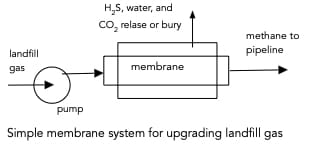
System for sewage gas upgrading, uses REB membranes.
C6 H12 O6 –> 3 CO2 + 3 CH4
This mix can not be put in the normal pipeline: there is too much CO2 and there are too many other smelly or condensible compounds (water, methanol, H2S…). This gas is sometimes used for heat on site, but there is a limited need for heat near a landfill. For the most part it is just vented or flared off. The waste of a potential energy source is an embarrassment. Besides, we are beginning to notice that methane causes global-warming with about 50 times the effect of CO2, so there is a strong incentive to capture and burn this gas, even if you have no use for the heat. I’d like to suggest a way to use the gas.
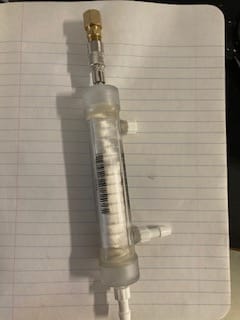
We sell small membrane modules too.
The landfill gas can be upgraded by removing the CO2. This can be done via a membrane, and REB Research sells a membranes that can do this. Other companies have other membranes that can do this too, but ours are smaller, and more suitable to small operations in my opinion. Our membrane are silicone-based. They retain CH4 and CO and hydrogen, while extracting water, CO2 and H2S, see schematic. The remainder is suited for local use in power generation, or in methanol production. It can also be used to run trucks. Also the gas can be upgraded further and added to a pipeline for shipping elsewhere. The useless parts can be separated for burial. Find these membranes on the REB web-site under silicone membranes.
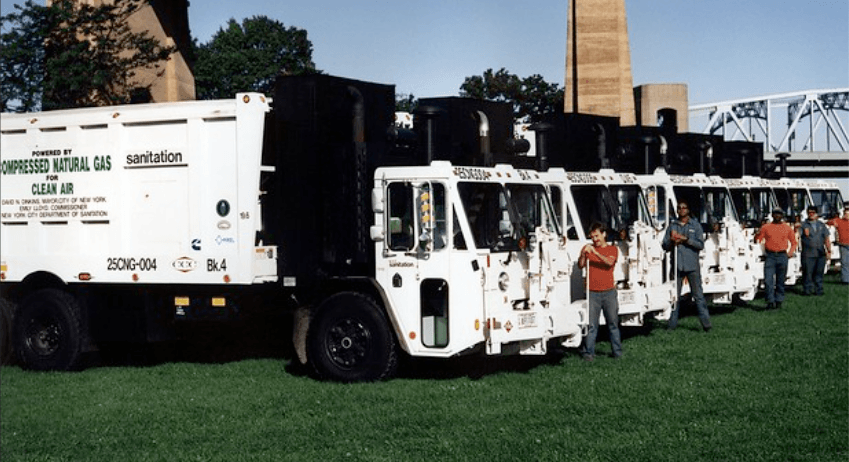
Garbage trucks in New York powered by natural gas. They could use landfill gas.
There is another gas source whose composition is nearly identical to that of landfill gas; it’s digester gas, the output of sewage digesters. I’ve written about sewage treatment mostly in terms of aerobic bio treatment, for example here, but sewage can be treated anaerobically too, and the product is virtually identical to landfill gas. I think it would be great to power garbage trucks and buses with this. Gas. In New York, currently, some garbage trucks are powered by natural gas.
As a bonus, here’s how to make methanol from partially upgraded landfill or digester gas. As a first step 2/3 of the the CO2 removed. The remained will convert to methanol. by the following overall chemistry:
3 CH4 + CO2 + 2 H2O –> 4 CH3OH.
When you removed the CO2., likely most of the water will leave with it. You add back the water as steam and heat to 800°C over Ni catalyst to make CO and H2. That’s done at about 800°C and 200 psi. Next, at lower temperature, with an appropriate catalyst you recombine the CO and H2 into methanol; with other catalysts you can make gasoline. These are not trivial processes, but they are doable on a smallish scale, and make economic sense where the methane is essentially free and there is no CNG customer. Methanol sells for $1.65/gal when sold by the tanker full, but $5 to $10/gal at the hardware store. That’s far higher than the price of methane, and methanol is far easier to ship and sell in truckload quantities.
The typical car has about 60 ft2 of exposed, non glass surface area, of which perhaps 2/3 is exposed to the sun at any time. If you covered the car with high-quality solar cells, the surfaces in the sun would generate about 15W per square foot. That’s about 600W or 0.8 horsepower. While there is no-one would would like to drive a 0.8 hp car, there is a lot to be said for a battery powered electric car that draws 6000 Wh of charge every sunny day — 6kWh per day– moving or parked — especially if you use the car every day, but don’t use it for long trips.
Owners of the Tesla sedans claim you can get 2.5 to 3 miles/kWhr for average driving suggesting that if one were to coat a sedan with solar cells, one day in the sun would generate 15 to 20 miles worth of cost-free driving power. This is a big convenience for those who only drive 15 to 20 miles each day, to work and back. As an example, my business is only 3 miles from home. That’s enough for the lightyear one, pictured below. The range would be higher for a car with a lighter battery pack, and some very light solar cars that have been proposed.
Lightyear one solar boosted plug in electric vehicle.
Solar power also provides a nice security blanket boost for those who are afraid of running out of charge on the highway, or far from home. If a driver gets worried during the day, he or she could stop at a restaurant, or park in the sun, and get enough charge to go a few miles, especially if you stick to country roads. Unlike gas-powered cars, where mpg is highest on the highway, electric vehicles get more miles per kWh at low speeds. It seems to me that there is a place for the added comfort and convenience of solar.


 (1)
(1) , of any pure material based not the pressure, the absolute temperature (Kelvin) and two, substance-specific constants,
  and
and  . These constants can be understood as an attraction force term, and a molecular volume respectively. It is common to calculate a and b from the
  ,
,  (2 a,b)