Category Archives: Engineering

Trump’s battleships, right size, perhaps too late

Donald Trump has announced his intent to build at least two battleships, the first built for our navy since the USS Missouri, 1944. The press has been largely negative on this, claiming that these ships are obsolete already, and will be more-so when they are completed — assuming they are completed. My sense is these are useful, overdue really, and I’d like to explain why.

The George Washington Carrier with nine surface support ships.

The centerpiece of America’s military power lies in our aircraft carrier groups, currently. We have 11 carriers in service: two modern, Ford class, and nine older, Nimitz class. Each of these weighs 100,000 tons, is 1100 feet long, and carries some 6000 men and women, 3200 navy crew, another 2500 in the air wing, and perhaps 300 support staff of doctors, nurses, and marines. Because they are vulnerable, each carrier travels in a group with six to ten other ships carrying an additional 3000 people, see photo. Without the support ships a carrier is deemed to be too vulnerable for use. Even with the support ships, Swedish and French submarines successfully “sank” U.S. carriers during exercises in 2005 and 2015. 

The support ships are typically slower than the carrier and difficult to maintain. Many are old with relatively short range. Our carriers can go around the world, 30000 miles, traveling at 30+ knots, but the main support ships, Arleigh Burke destroyers, 9000 tons, 350 crew, have a range of only 4,400 nmi  at a slower, 20 knots. They require regular refuelings for any major mission, like patrolling the Caribbean. Still, they’re “cheap,” about $2.5B each, capable, and work relatively well. We have some 75 in service, built since 1991, with more on order.

We also have nuclear missile submarines, but these are blunt instruments of policy, not suited to most navy missions, like keeping open shipping lanes in the Red Sea or stopping ISIS, or for blockading Venezuela. The mostly hold weapons of last resort.

The navy has recognized the need for a larger support ship for better carrier protection and more flexible roles, a cruiser likely, with good range and weapons, and with enough speed to keep up with a carrier crossing the Pacific. We’ve built many cruisers over the years, but these are old. Our latest are the Ticonderoga class  guided-missile cruisers built from 1980 onward. They have good speed, 32.5kn, and good range, 6000nm, but are well past their retirement date, and break down a lot. Only 7 are still in service.

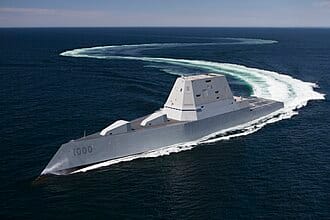
The USS Zumwalt at sea. Trump said it was “Ugly as F.”

The supposed replacement, was a cruiser-size, stealth ship, the Zumwalt destroyer, 17,000 tons and 600 feet long. It is reasonably fast, 33.5kn, and carries a small crew, <100. We’ve managed to build three of these since 2008, but have cancelled the project due to operational problems and costs that rose to $8B per ship. Zumwalts have inward-sloped sides that deflect radar, but they become unstable in turns. Its main weapons are expensive, too: Aegis missiles and CPS hypersonics costing $28-$50 million each. That’s uneconomical compared to French Aster missiles, Mach 3, 80 mile range, $1.1 million. Originally, Zumwalt destroyers carried a rail gun, but it required so much power that you could not move the ship and fire at the same time. The rail guns were eventually replaced by conventional 5″ cannon with a 24 mile range. The three Zumwalts we have are hardly used today, and no more are on order. Something cheaper was needed at least for support, and that was supposed to be the Constellation Frigate, approved by Trump in 2017.

A frigate is smaller than a cruiser, in this case about half the weight. The Constellation was a proven Italian design, 492 feet long and only 7,291 tons. It had good speed, 26 kn, good range, 6000 nm at 16kn, and cost only $950 million, at least when built in Europe. The contract was awarded to Fincantieri Marinette Marine (FMM) of Marinette Wisconsin, the US division of the Italian company. What could go wrong? The problem was that the navy kept adding capabilities and weight. As of November 2025, eight years on, the weight had increased by 700 tons, the cost to $9 B for two, and no design has been finalized. The first Constellation frigate is only 12% built! Trump has not quite cancelled the program, but has reduced the order to two from the original eight.

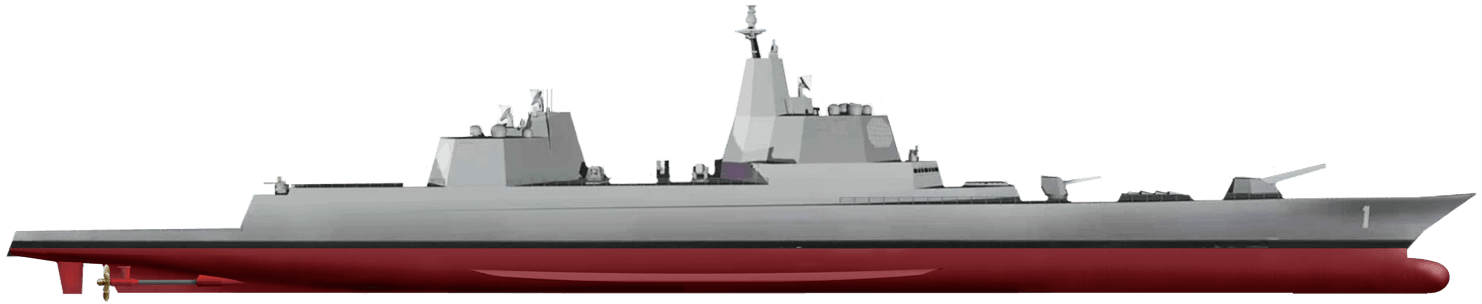
Trump-class battleship, as envisioned, with a rail-gun, lasers and two, conventional 5″ cannon.

And that brings us to the current, Trump class battleship, shown above. It’s long, 840-880 feet, and heavy, 39,000 tons, or 2.5 times the weight of the cruiser-sized, Zumwalt. As was intended for the Zumwalt, the offensive weapons are missiles and a rail gun, 32 MJ, but now there is enough power run the ship and fire the weapon. Japanese versions of the rail gun have launched cheap shells at hypersonic speeds, ~5000 mph (hypersonic) at up to one per second to 100 miles. The shells cost only $85,000 each, a bargain.

For defense, these battleships are to carry two, 300kW, Helios lasers, similar to Israel’s “Iron beam,” but 3 times as powerful. They are augmented by smaller lasers, by four, 30 mm chain guns (Gatling guns), and two, 5″ conventional navy guns of 24 mile range. Engines are estimated to be two gas turbines, perhaps 50MW each, to power the weapons, plus ~100 MW in diesel power for cruising at good mpg. I thus estimate a total of ~200 MW, about as much as on a carrier. There is plentiful space for missiles and fuel too, and it should be ale to do some resupply of support ships. The crew size is bigger than on the Ticonderoga, 600 to 800, but far less than on a carrier. And the look is impressive. It could be a command ship. Still, there are objections.

A main complaint is vulnerability as discussed here. Some see these ships are “bomb magnets,” not stealthy, nor as heavily armored as the Iowas, with lasers and chain guns insufficient to defend them, e.g. from dedicated swarm attacks. Detractors note that Battleships like the Bismarck, Yamamoto, and Arizona have been sunk, typically by air attack, but what they don’t mention is that it took a lot of bombs and torpedos to sink these battleships. Also these battleships will typically travel with support.

Detractors also question the rail gun. Can it shoot down an airplane? can it sink a ship? We don’t know. They point of that the cost and construction time of the ship is high and likely to balloon. Wouldn’t it make more sense to fix the Constellation or the Zumwalt. The tests I’ve seen suggest that the rail gun can not sink a ship with one shot; that still needs a missile. If the gun can hit a plane or missile, it will destroy it, but accuracy may not be sufficient, at long range. The gun seems appropriate for shore bombardment and for slowing a Chinese navy that is already bigger than ours. As for the defensive lasers, these have been shown to stop drones and cruise missiles at a cost of only $10 per shot: nothing compared to a harpoon missile ($1.4 million each) or Aegis ($28 million). I don’t see a smaller ship being able to power these weapons, especially if you want extra room for expansion, like adding a nuclear reactor.

The time-line is what worries me most. For ten years at least, we will have to rely on short-range Arleigh Burkes that could not bombard the Houthis effectively on land, did not effectively defend US shipping in the Red Sea, and that uses million-dollar missiles to shoot down $20,000 drones. And in ten years, will we still want it.

Robert Buxbaum, January 5, 2026. As a totally side issue: I doubt this is a battleship: It currently carries only one powerful gun. You need at least two to be a battleship, IMHO.

Drying hydrogen with polymeric membranes

Generally, when you make hydrogen, you make wet hydrogen, hydrogen contaminated with water. Usually you want to dry the hydrogen before you use it or compress it. if you compress the hydrogen for transport or storage without drying it, the water will condense and perhaps freeze, clogging valves and fittings.

Water contamination of hydrogen is also a problem for brazing. Hydrogen is a good, cover gas for brazing because of its high heat transfer properties and its reducing chemistry. When the hydrogen is contaminated with water vapor it is unstable for use with stainless steel and similar metals as it will cause oxidation of the surface, resulting in a grey-green surface, and preventing good brazing. Some other contaminates can be problems, e.g. CO2 but water is the main problem in brazing environments.

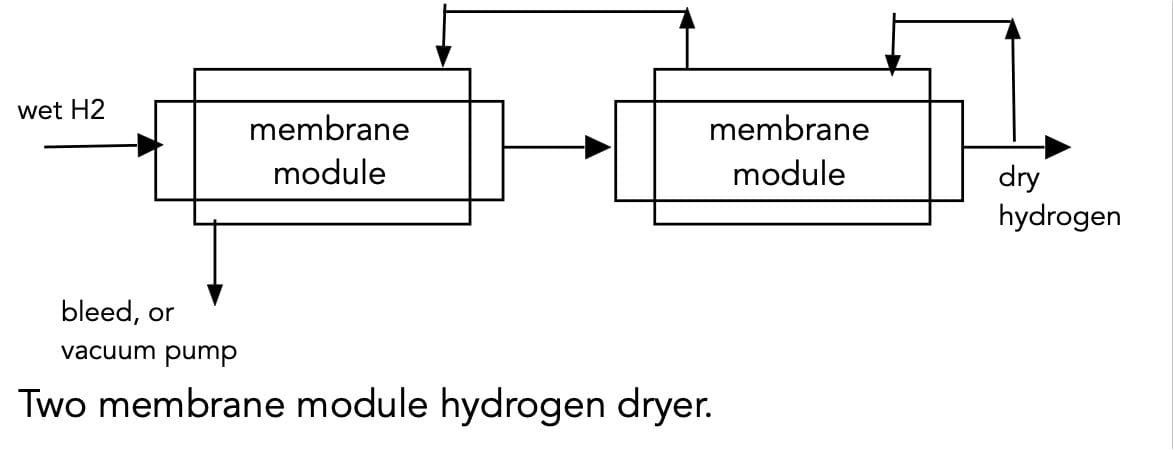
One more example where drying hydrogen is important, is for its use in high altitude balloons. At high altitudes, water can condense, changing the lift characteristics, and perhaps freezing and puncturing the balloon. For all these applications, I suggest use of a silicone polymeric membrane operated as dryers, using a counter current flow as shown below. We sell these at REB Research, see here. These membranes also remove CO2, silanes, and H2S.

The dryer shown in the figure above has two extraction modules in series. for small flows, one module will suffice. As shown, wet hydrogen enters at left, typically at a slightly elevated pressure, 2-4 atm. The bleed stream must be at lower pressure. One atm will work for the bleed stream, but for efficient removal of the water and CO2, you will want mild vacuum, perhaps 1/3 atm. A small amount of dry hydrogen should be directed into the sweep stream as shown for efficient impurity removal. The amount directed to the bleed flow is large determined by the ratio of pressures and by the selectivity of the membrane. At a pressure ratio of ten, for example, you can show that you need at least a leaving bleed flow of 10% of the H2 to remove all the water in the hydrogen, leaving it perfectly dry. In practice, you’ll want a larger exit bleed flow, perhaps 15%, suggesting that you want a recycle stream of ~5% of the dry hydrogen. This will be joined by 10% more hydrogen that comes through the membrane modules. The membranes are 30x more selective to water than to hydrogen.

A silicone module of 0.1m2

Our silicone membranes remove CO2 too, but not with as high a selectivity. For mobile use, you might want to power the vacuum pump by a fuel cell that runs on the waste, wet hydrogen of the bleed stream.

For many applications you need to remove all the impurities, including all the nitrogen and CO2. This is true for diamond making, semiconductors, and nuclear fusion. For this, you want a metallic membrane, e.g. palladium-silver. We sell hydrogen purifiers based on palladium-silver membranes for these applications. Palladium-silver membranes remove all impurities, see why here. You still need a bleed flow, but it can be much lower than the pressure ratio because, with metallic membranes, the hydrogen goes through the membrane, and the impurities stay behind. Of course, palladium costs more than plastics. See our products at www.rebresearch.com.

Robert Buxbaum, December 19, 2025

What causes innovation? is it worth it?

Innovation is the special sauce that propels growth and allows a country to lead and prosper. The current Nobel prize believe that innovation powered the Industrial Revolution, causing England to become rich and powerful, while other nations remained poor, weak, and stagnant. Similarly, Innovation, they believe is why 19th century Japan rose to defeat China, and propelled China’s 21st century rise. But why did they succeed when others did not. What could the leader of a country do to bring power and wealth through innovation. Improved education seems to help; all of the innovation countries have it, but it is not the whole. Some educated countries (Germany, Russia) stagnate. An open economy is nice, but it isn’t sufficient or that necessary: (look at China). That was the topic of this year’s, 2025 Nobel prize in economics to Mokyr, Howitt, and Aghion, with half going to Joel Mokyr for his insights, historical and forward looking, the other half going for economic modeling. I give below my understanding of their insights, more technical than most, but not so mathematical as to be obtuse the normal reader..

The winners hold that innovation, as during the industrial revolution, is a non-continuous contribultion caused by a particular combination of education and market opportunity, of theoretical knowledge, and practical, and that a key aspect is depreciation (destruction) of other suppliers. Let’s start by creating a simple, continuous function model for economic growth where growth = capital growth, that is dK/dt. K, Capital, is understood to be the sum of money, equipment, and labor knowledge, and t is time with dK/dt, the change in K with time modeled as equal to the savings rate, s, times economic activity, Y minus a depreciation factor, δ, times capital, K.

growth = dK/dt = sY − δ K.

Innovation, in the Howett model, is discontinuous and accumulative. It builds on itself.

For the authors, Y = GDP + x, where x is the cost of outside goods used. They then claim that Y is a non-linear function of K, where K is now considered a product of capital goods and labor K = xL and,

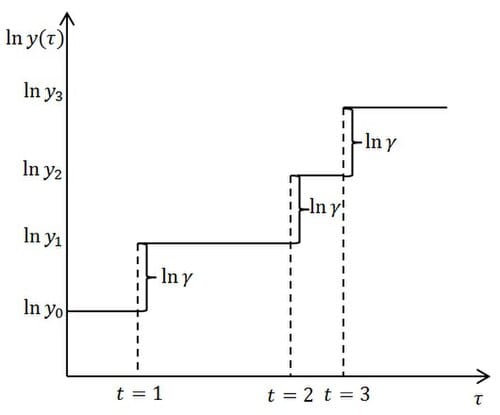
dY/dK = AKα + γ where 0< α <1, and where γ is the contribution of innovation and/or depreciation. The power function, as I understand it, is a mathematical way of saying there are economies of scale. The authors assume a set of interacting enterprises (countries0 so that the innovation factor, γ for one country is the depreciation factor for the other. That is, growth and destruction are connected, with growth being a function of monopoly power — control of your innovation.

According to the Nobel winners, γ is built n previous γ as shown in the digram at right. It can not be predicted as such, but requires education and monopolistic power. The inventor-manufacturer of the typewriter has a monopolistic advantage over the makers of fountain pens. Innovation thus causes depreciation, δ K as one new innovation depreciates many old processes and products. If you add enough math, you can derive formulas for GDP and GDP growth, all based on factors like A and α, that are hard to measure.

GDP = α(2α/1−α) (1-α2)A L,

Thus, GDP is proportional to Labor, L and per-capita GDP is mostly an independent function related to economies of scale and the ability to use capital and labor which is related to general country-wide culture.

The above analysis, as I understand it, is in contrast to Kensyan models, where growth is unrelated to innovation, and where destruction is bad. In these Kenysean models, growth can be created by government spending, especial spending to maintain large industries with economies of scale and by spending to promote higher education. The culture preferred here, as I understand is one that rewards risk-taking, monopoly economics, and creative destruction. Howitt, and Aghion, importantly codify all this with formulas, as presented above that (to me) provide little specific. No great guidance to the head of a country. Nor does the math make the models more true, but it makes the statements somewhat clearer. Or perhaps the only real value of the math is to make things sound more scientific see the Tom Lehrer song, Sociology.

This insight from movie script by Grham Green suggests to me that progress may not be the greatest of advantages, perhaps not even worth it.

This work seems more realistic, to me, than the Keynesian models Both models are mathematically consistent, but if Keynes’s were true, Britain might still be on top, and Zambia would be a close competitor among the richest countries on earth. Besides these new fellows seem to agree with the views of Peter Cooper, my hero. See more here.

Writing all this reminds me that the fundamental assumption that progress is good, in not necessarily true. I quote above a line that Orson Wells, as Harry Lime, ad-libbed for the movie, “The Third Man.” Lime points out that innovation goes with suffering, and claims that Switzerland had little innovation because of its stability. Perhaps then, what you really want is the stability and peace of Switzerland, along with the lack of domination and innovation. On the same note, I’ve noticed that engineering innovators often ruin themselves dining in ruin, while the peaceable, stable civil engineers live long pleasant lives of honor.

Robert Buxbaum, November 16, 2025. A note about Switzerland is that was peaceful and stable because of a strong military. As Publius Vegetius wrote, Si vis pachim para bellum (if you wish of peace, prepare for war).

So long to the SS United States, the fastest ocean liner.

The SS United States is in the process of being towed to its final resting place, on the sea floor near florida, to be a scuba-diving reef. She is the largest ocean liner to be entirely constructed in the United States and was the fastest ocean liner to cross the Atlantic Ocean in either direction, 36 knots or 41 mph average speed. She won the Blue Riband for this on her first voyage, in 1952, and retained that title till today. There was a faster crossing in June, 1990 by the Hoverspeed Great Britain, 36.6 knots, 42.1 mph average speed, but the Hoverspeed was a 76 meter channel catamaran, not an ocean liner.

The SS United States was half-paid for by the US government. Its purpose was fast passenger transport across the Atlantic. The government contributed because it might be used as a troop ship if needed in times of war. In terms of speed, she handily beat the luxurious British liners, Queen Elizabeth and Queen Ann, but the compromises for speed and military use made the SS United States unsuited for use as a luxury cruise ship.

Designed by William Francis Gibbs, one of the greatest ship designers, the high speed was achieved, in part, by making the ship very light. He used aluminum for the entire superstructure, the stuff above water level, making it the largest aluminum construction when built, 1951. Though larger than the Titanic, the United States is thinner and more pointy. Much lighter than the Queen Elizabeth or Queen Ann, she could go as fast backward as the Titanic could forward. The hull is doubled, with fuel stored between the layers as a protection from collisions and canon; the interior is highly compartmentalized too, to make her fairly unsinkable. This was confirmed when she survived a sea collision shortly after launch. Making the ship light on the top made the SS United States stable in wind and rough seas despite its narrow shape. There were two engine sections, divided into four engine rooms, done to increase the chances that the engines would survive an explosion or torpedo attack.

The interior design was American modern, and fire-proof, with few weighty decorations. Furnishings were fiberglass, steel or aluminum, for the most part, see picture below. The red, white, and blue stacks added to the American look. Both are used (recall that there are two engine rooms), and both have aluminum wings. These shield the deck from any sparks that might come out the stacks.

In the end, it was the crossing speed not the comfort level that doomed the SS United States. Even at a top speed of 44.1 mph, crossing the Atlantic took 3+ days. That could not compete with jet planes that travelled at 500 mph. I’ve argued that long range, “high speed” passenger trains make little sense for the same reason. Even at 100+ mph, few Americans will be willing to spend 36 hours traveling from Chicago to Seattle. Fast boats are useful, I think, but only in smaller size foreshorten trips, similar to the Hoverspeed.

5 blade propeller on display at Throg’s neck. Paired with a 4 blade propeller it reduced vibration and wear at high speed.

Also helping it reach the speeds it did, the SS United States benefitted from innovations in the engines and in the propellers. There were four engines, in two engine sections. These were modern, light weight, compact, steam turbines running at high pressures and temperatures: 975°F and 925 psi. Each turbine delivered 60,000 shaft hp to a variable-speed, geared shaft. The inboard propellers had 5 blades and the outboard (end of ship) had four. This difference in blade number was a secret, design innovation that allowed faster speed, without vibration and cavitation. The 5 blade propeller shown on display at left, accelerated the water, while the 4 blade accelerated it faster. At the time, this was secret technology. We now have some better propellers, though no faster ocean liners. The Hoverspeed uses water jet for propulsion, by the way.

Leaving the Delaware River heading to the Gulf of X

On its way to the bottom of the sea, the ship will first stop at MARS. That is not the planet Mars, but at an engineering firm, “Modern American Recycling Services” in Mobile Alabama, on The Gulf of X. There the MARS folks will prepare the ship to sink in an even way, where its supposed to; a way that works for scuba divers.

Robert Buxbaum, February 28, 2025. My sense is there is still room for steam power. I also think the US government should return to investing in US ship-building, especially for double-use, military and commercial, like this one. A new favorite phrase, from Ovid, Metamorphosis: “Omnia mutantur, nihil interit”. Everything changes, but nothing passes away. RIP, old friend.

Coal and nuclear power, the secret to China’s cheap products

We’ve become accustomed to buying cheap products from China: items made of glass, plastic, and metal come to the US by the ship-load, approximately $600 B worth last year, the highest from any country. Labor isn’t cheaper in China, certainly not when compared to Mexico or India, nor are the machines that make the products more advanced. What’s behind China’s ability to produce at their low prices is cheap energy—specifically, coal and nuclear-based electricity. While the US and most western countries have shut down coal plants to stop global warming, and have even shut working nuclear reactors for no obvious reason, China has aggressively expanded coal and nuclear energy production. The result? They are the largest single source of CO2, and have some of the lowest electricity prices in the world, Chinese electricity prices are about 1/4 of European, and 2/3 of U.S.

In recent years, the U.S. and Europe have increasingly relied on renewable energy sources like wind and solar. While these can work in certain areas, they require far more land than nuclear or coal, and expensive infrastructure because the power is intermittent, and generally not located close to the customer. The UK and Germany, countries with long periods of cloudy, windless conditions, have switched to solar and wind, leading to soaring electricity prices and a moribund industrial sector. Germany shut down all of its nuclear plants, 17 of them, largely to rely on electricity imported from its neighbors, and coal-fired sources that are far more polluting and unsafe than the nuclear plants they shut. The UK shut 5 nuclear reactors since 2012.

Meanwhile, China continues to build nuclear and coal plants. China is the largest user of coal power, and is planning to build 100 more coal-fired plants this year. Beyond this, China is building nuclear power rectors, including the world’s first 4th generation reactor (a pebble bed design). China has built 20 nuclear plants since 2016, and has 21 under construction. With this massive energy advantage, China produces things at low price for export: appliances, clothes, furniture, metal and plastic goods, all at a fraction of our cost. By selling us the things we used to make, China imports our jobs and exports pollution from their coal plants.

Many people instinctively understand that outsourcing production to China is harmful to both US employment and world pollution. Yet, until recently, US politicians encouraged this transfer through trade agreements like the TPP. Politicians bow to high-spending importers, and to environmental activists. It seems we prefer cheap goods to employment, and we’re OK with pollution so long as we don’t see the pollution being made. But, by outsourcing production, we’ve also outsourced control over critical industries, we’ve limited out ability to innovate, and we make ourselves dependent on China. Likely, that was part of China’s intent.

Russia has followed a similar path, keeping electricity costs mostly through low through coal, but also nuclear power, exporting their goods mostly to the EU. Before the Ukraine war, Germany in particular, relied on Russian gas, electricity, and fertilizer, products of Russian cheap power. By cutting off those energy, Germany has dealt a severe blow to its economy. Not everyone is happy.

Transfer of electricity, GWh, between European countries, 2023. Energy is most expensive in importer-nations, and GDP growth is slowest.

The incoming Trump administration has decide that, to compete with China’s manufacturing power, we need to develop our own through tariffs, and we need to increase our energy production. Tariffs can help balance the budget, and bring production back home, but without more energy, our industries will struggle to produce. I’m generally in support of this.

US production is more energy efficient than Chinese production, and thus less polluting. Besides, making things here saves on transport, provides jobs, and helps to build US technology for the future. I’m happy to see us start to build more nuclear power reactors, and restart some old plants. Solar and wind is good too, but is suited to only in some areas, windy and sunny ones, and even there, they need battery storage so that the power is available when needed.

Robert Buxbaum, January 21, 2025

Bendy hockey sticks, and my, half-bendy version.

Hockey sticks have gotten bendier in recent years, with an extreme example shown below: Alex Ovechkin getting about 3″ of bend using a 100# stiffness stick. Bending the stick allows a player to get more power out of wrist shots by increasing the throw distance of the puck. There is also some speed advantage to the spring energy stored in the stick — quite a lot in Mr Ovechkin’s case.

Alexander Ovechkin takes a wrist shot using a bendy stick.

A 100# stiffness stick takes 100 pounds of force in the middle to get 1″ of bend. That Ovechkin gets 3″ of bend with his 100# stick suggests that he shoots with some 300 lbs of force, an insane amount IMHO. Most players use a lot less force, but even so a bendy stick should help them score goals.

There is something that bothers me about the design of Alex Ovechkin’s stick though, something that I think I could improve. You’ll notice that the upper half of his stick bends as much as the lower half. This upper-bend does not help the shot, and it takes work-energy. The energy in that half of the bend is wasted energy, and its release might even hurt the shooter by putting sudden spring-stress on his wrist. To correct for this, I designed my own stick, shown below, with an aim to have no (or minimal) upper bend. The modification involved starting with a very bendy stick, then covering most of the upper half with fiberglass cloth.

I got ahold of a junior stick, 56″ long with 60# flex, and added a 6″ extension to the top. Doing this made the stick longer, 62″ long (adult length) and even more bendy. One 1″ of flex requires less force on a longer stick. I estimate that, by lengthening the stick, I reduced it to about 44#. Flex is inversely proportional to length cubed. I then sanded the upper part of the stick, and wrapped 6 oz” fiberglass cloth (6 oz) 2-3 wraps around the upper part as shown, holding it tight with tape at top and bottom when I was done. I then applied epoxy squeezing it through the cloth so that the composite was nearly transparent, and so the epoxy filled the holes. This added about 15g, about 1/2 oz to the weight. Transparency suggested that the epoxy had penetrated the cloth and bonded to the stick below, though the lack of total transparency suggests that the bond could have been better with a less viscous epoxy. Once the epoxy had mostly set, I took the tape off, and stripped the excess fiberglass so that the result looked more professional. I left 23″ of fiberglass wrap as shown. The fiberglass looks like hockey tape.

Assuming I did the gluing right, this hockey stick should have almost all of the spring below the shooter’s lower hand. I have not measured the flex, but my target was about 80 lbs, with improved durability and the new lower center of bend. In theory, more energy should get into the puck. It’s a gift for my son, and we’ll see how it works in a month or so.

Robert Buxbaum, December 5, 2024.

Check the screws on your door locks.

Original hardware brass screws from my door and locks, plus one of the stainless screw that I used as a replacement.

I just replaced the door knob assembly on my home and found that it was held in place by a faceplate that was attached by two, 5/8″, brass screws. These screws, shown at right with their replacement, would not have been able to withstand a criminal, I think. Our door is metal, foam filled, and reasonably strong. I figure it would have withstood a beating, but the brass screws would not, especially since only 1/4″ of the screw is designed to catch foam. Look closely at the screws, and you will see there are two sizes of pitch, each 1/4 long. Only the last 1/4″ looks like it was ever engaged. The top 1/4″ may have been designed to catch metal, but the holes in the door were not tapped to match. The bottom 1/4″ held everything. Even without a criminal attack, the screw at right was bent and beginning to go.

Instead of reusing these awful screws or buying similar ones, I replaced them with stainless screws, 1 3/4″ long, like the one shown in the picture above. But then I had a thought — what were the other locks on my door attached with? I checked and found my deadbolt lock was held in by two of the same type of sorry, 5/8″ brass screws. So I replaced these too, using two more, 1.75″ stainless steel. Then, in my disgust, I thought to write this post. Perhaps the screws holding your door hardware is as lousy as was holding mine. Take a look.

Robert Buxbaum, November 28, 2024

Sailors, boaters, and motor sailing at the hull speed.

I’ve gone sailing a few times this summer, and once again was struck by the great difference between sailing and boating, as well as by the mystery of the hull speed.

Sailors are distinct from boaters in that they power their boats by sails in the wind. Sailing turns out to be a fairly pleasant way to spend an afternoon. At least as I did it, it was social, pleasant, and not much work, but the speeds were depressingly slow. I went on two boats (neither were my own), each roughly 20 feet long, with winds running about 10-15 knots (about 13 mph). We travelled at about 3 knots, about 3.5 mph. That’s walking speed. At that speed it would take about 7 hours to cross Lake St. Clair (25 miles wide). To go across and back would take a full day.

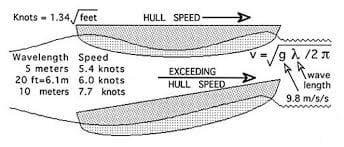
Based on the length of the boats, they should have been able to go a lot faster, at about 5.8 knots (6 mph). This target speed is called the hull speed; it’s the speed where the wave caused by the bow provides a resonance at the back of the boat giving it a slight surfing action, see drawing.

This speed can be calculated from the relationship between wave speed and wavelength, so that Vhull = √gλ/2π where g is the gravitational constant and λ is the water line length of the boat. For Vhull in knots, it’s calculated as the square-root of the length in feet, multiplied by 1.34. For a 20 foot boat, then,

Hull speed, 20′ = 1.34 √20 = 1.34 x 4.5 = 6.03 knots.

While power boats routinely go much faster than this, as do racing skulls and Americas cup sailboats, most normal sailboats are designed for this speed. One advantage is that it leads to a relatively comfortable ride. There is just enough ballast and sail so that the boat runs out of wind at this speed while tipping no more than 15°. Sailors claim there is a big increase in drag at this speed, but a look at the drag profile of some ocean kayaks (12 to 18 feet, see below) shows only a very slight increase around this magical speed. More important is weight; the lowest drag in the figure below is found for the shortest kyack that is also the lightest. I suspect that the sailboats I was on could have gone at 6 knots or faster, even with our current wind, if we’d unrolled the spinnaker, and used a ‘screecher’ (a very large jib), and hung over the edge to keep the boat upright. But the owner chose to travel in relative comfort, and the result is that we had a pleasant afternoon going nowhere.

Data from Vaclav Stejskal of “oneoceankyacks.com”

And this brings me to my problem with power boating. Th boats are about the same length as the sailboats I was in, and the weight is similar too. You travel a lot faster, 20 to 25 knots, and you get somewhere, but the boats smell, and provide a jarring ride, and I felt they burn gas too fast for my comfort. The boats exceed hull speed and hydroplane, somewhat. That is, they ride up one wave, fly a bit, and crash down the other side, sending annoying wakes to the sailboaters. We crossed lake St. Clair and rode a way down the Detroit river. This was nice, but it left me thinking there was room for power -assisted sailing at an intermediate speed, power sailing.

Both sailboats I was on had outboard motors, 3 hp, as it happened, and both moved nicely at 1 hp into and out of the harbor, even without the sail up. Some simple calculations suggest that, with I could power a 15 to 20 foot sailboat or canoe at a decent speed – hull speed – by use of a small sail and an electric motor drawing less than 1 hp, ~400 W, powered by one or two car batteries.

Consider the drag for the largest, heaviest kayak in the chart a move, the Cape Ann Double, going at 6.5 knots. At 6 knots, the resistance is seen to be 15 lbs. To calculate the power demand, convert this speed to 10 fps and multiply by the force:

Power for 6 knot cruising = 10 fps x 15 lbs = 150 ft lbs/s = 202 W or 0.27 hp.

Outboard motors are not 100% efficient, so let’s assume that you need to draw more like 250 W at the motor, and you will need to add power by a sail. How big a battery is needed for the 250 W? I’ll aim for powering a 4 hour trip, and find the battery size by multiplying the 250 W by 4 hours: that’s 1250 Hrs, or 1.25 kWh. A regular, lithium car battery is all that’s needed. In terms of the sail, I’m inclined to get really invovative, and use a Flettner sail, as discussed here.

It seems to me that adding this would be a really fun way to sail. I’d expect to be able to go somewhere, without the smell, or the cost, or being jarred to badly. Now, all I need is a good outboard motor, and a willing companion to try this with.

Robert Buxbaum, Sept. 9, 2024

China’s space station and the ISS, a comparison

It gets so little notice from the news agencies that many will be surprised to find that China has a space station. It’s known alternately as the Tiangong Space Station or the CSS, Chinese Space Station; it’s smaller than the International Space Station, ISS, but it’s not small. Here is a visual and data comparison, both from Wikipedia.

China’s space station is smaller than the ISS, but just about as capable. Cooperation leads to messiness (and peace?)

The ISS has far more solar panels, but the power input is similar because the CSS panels are of higher efficiency. As shown in the table below, the mass of the ISS is about 4.5 times that of CSS but the habitable volume is only 3 times greater than of CSS, and the claimed crew size is similar, of 3 to 6 compared to 7. The CSS is less messy, less noisy, with less mass, and more energy efficiency. Part of the efficiency comes from that the CSS uses ion propulsion thrusters to keep the station in orbit, while the ISS uses chemical rockets. The CSS thus seems better, on paper. To some extent that’s because it’s more modern.

Another reason that the ISS is more messy is that it’s a collaboration. A major part of its mission is to develop peaceful cooperation between the US, Europe and Russia. It’s been fairly successful at this, especially in the first two decades, and part of making sure parts from The US, Russia, Europe, Japan, and Canada all work together is that many different standards must be tolerated and connected. The ISS tolerates different space suits, different capsules, different connections, and different voltages. The result is researchers communicate, and work together on science, sending joint messages of peace to the folks on earth. Peace is an intended product.

By contrast, the Chinese space station is solely Chinese. There are no interconnection issues, but also no peace dividend. It has a partially military purpose too, including operation of killer satellites, and some degree of data mining. This was banned for ISS. So far the CSS has hosted Chinese astronauts. No Chinese astronauts have visited the ISS, either.

Long march 6A rocket set to supply the CSS. It is very similar to the Delta IV.

India was asked to join the ISS, but has declined, wishing to follow China’s path of space independence. The Indian Space Research Organization plans to launch a small space station on its own, Gaganyaan, in 2025, and after that, a larger version. That’s a shame, though it’s not clear how long cooperation will continue on the ISS, either. See the movie I.S.S. (2023) for how this might play out. Currently, there is a tradition of cooperation about ISS, and it’s held despite the War in Ukraine. The various nations manage to work together in space and on the ground, launching people and materials to the ISS, and working together reliability.

Although it isn’t a direct part of the space stations, I should mention the troubles of the Boeing Star-liner capsule that took two astronauts to the ISS compared to the apparently flawless record of the CSS. The fact is, I’m not bothered by failures, so long as we learn from them. I suspect Boeing will learn, and suspect that this and other flailing projects would be in worse shape without the ISS. Besides, the ISS has been a major catalyst in the development of SpaceX, a US success story that China seems intent on trying to copy. SpaceX was originally funded, at low level, to serve as a backup to Boeing, but managed to bypass them. They now provide cheaper, more reliable travel through use of reusable boosters. The program supplying CSS uses traditional, disposable rockets, the Long March 5 and 6 and 7. These resemble the Atlas V, Delta IV and Delta IV Heavy. They appear to be reliable, but I suspect they are costly too. China is currently developing a series of reusable rocket systems. The Long March 9, for example will have the same lift capacity as SapceX’s Starship, we’re told. Will the Indian program choose this rocket to lift their space station, or will they choose SpaceX, or something else? The advantages of a reusable product mostly show up when you get to reuse it, IMHO.

Robert Buxbaum, September 10, 2024.

Germany’s hydrogen trains and boats almost make sense

Germany’s green transition is a disaster. Twenty years ago, Germany had 23 nuclear power plants that generated 30% of the country’s electricity cleanly, cheaply, and reliably. These plants have all been shut by the government as part of a commitment to clean energy. What could be cleaner? Germany has switched to a mix of wind and solar, plus a significant shift to coal power. Wind and solar use a lot of land compared to nuclear, and they break down leaving fields of debris. There is now a lack of electricity to power homes and industries, and what power there is, is unreliable, due to the many dark windless days in Germany.

The lack of reliable electricity is crippling German industry now that Russian gas has been cut off. In this environment, why would the Germans order special trains and boats that burn, hydrogen that’s made from electricity and natural gas? The reason is that Germany sometimes has too much wind power and nothing to do with it. They plan to store this excess by making hydrogen that they can use to power their trains and boats. The cost is high, and the efficiency is poor, but the electricity is free.

A better answer would be battery storage, IMHO, or using the hydrogen to make liquid fuels (gasoline) from wood. Hydrogen is not a compact fuel like gasoline, but it’s cleaner. Compressing hydrogen to high pressure helps, and H2 storage is cheaper than batteries. Also, hydrogen fuel is transferred faster than electric fuels. Trains and ships are chosen for hydrogen because they can carry bulky items tanks. Also, many trains and boats are already powered by electricity. Hydrogen fuel cells can make the electricity on board (in theory), while avoiding the need for expensive overhead wires. The idea sort-of makes sense.

Germany’s first hydrogen train. cancelled after 1 year of poor operating.

The first hydrogen-powered train in Germany, The Hannover line, used fuel cells to generate electricity. It began service in October 2022, but the fuel cells proved unreliable, and service ended October 2023. For now, they are powered by polluting diesel (see here). They plan to switch to battery-powered trains over the next few years. A hydrogen-powered ferry is also planned, but it is not clear why the ferry should be more reliable than the train.

San Francisco’s hydrogen-powered ferry, $30 million, 15 knots top speed, 75 passengers, no cars. Long delayed.

In the US, the Biden administration has paid, so far, $30 million for a hydrogen ferry in San Francisco. It’s two years behind schedule and over cost, taking only 75 passengers and no cars at 15 knots, 17mph. In the US, and likely in Germany, most of the hydrogen will be made from natural gas. A better solution, I think would be to power the ferris and trains by natural gas and to store the excess electricity in land-based batteries or as land-based hydrogen for land-based fuel cells.

Germany is committed to electric trains, though, and hydrogen provides a route to power these trains with excess electricity. German customers take the train, in part, because they like them, and in part because German politicians have banned short-hop planes on competing routes, and subsidized electric trains. Yet another option to balance times of excess solar and wind power would be to subsidize electric cars, or at least allow theirs owners to trade electricity: to buy electricity when it’s cheap and resell it to the grid when demand and prices are high.

Robert Buxbaum, June 8, 2024