There is no truly good way to give representative voices to a population. The founders of the country decided that there would be a set number of congresional representatives, divided it by states, and left it to the individual states to subdivide, with a few provisos. They mandated that congressional districts have to be contiguous, entirely within a state, and contain approximately the same number of citizens in each. A later law specified that the districts should not directly disadvantage a racial minority. Within these parameters, legislators in most states have divided congressional districts to advantage those in power to a greater or lesser extent. The most egregious of these are Gerrymanders, odd shaped districts that protect sitting congressmen and parties, as bad as the worst of these are, they are better than some, truly awful, “fair” divisions, in my opinion.
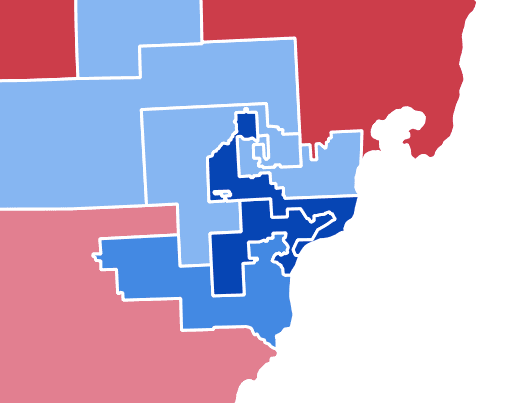
This was Michigan’s district map (Detroit area) until redrawn by independent commission, 2022. My district was the dark blue one that looked like a man in a chair.
Consider my state: Michigan, a swing state that voted for both Biden, and Trump. Currently the state house is 52% R and 48% D, but Democrats were in majority as recently as 2024. Our congressional district map used to be a disaster, shown at left. In 2022 it was replaced by a map created by an independent committee that aimed for roughly square districts that aimed to keep towns and communities together. The result is that most districts are either safe D or safe R. This, we’re told, is bad in that it leads to factionalism, with congressmen pandering to political extremes, with little incentive to compromise.
A fairer alternative (?) would divide the congressional districts so that all or most district are swing, like the state. Supposedly such districts would elect moderates who compromise. This version, though no-less fair than the above, is not good, in my opinion. I expect it creates chaos and turnover. I’m also not convinced that compromise is always best.
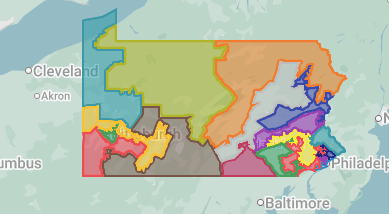
Pennsylvania’s congressional map before redistricting by independent committee. Ugly, but fair in its way.
The variant of this that preceded our current is for congressmen and others in power to create districts that are fairly safe for themselves and their party, leaving those of the other party in a few, super-concentrated districts. This division is less fair, but far more stable and workable. It lead to ugly gerrymander districts in Michigan (left) and Pennsylvania (below). This is not bad in itself. What was bad about these gerrymanders is that the congress folk, secure in their jobs, formed a political aristocracy. Seats passed from generation to generation, and ruled fairly disconnected from the wishes of those they represented. A good part of the aristocracy is that they worked well with each other, across party lines. They were friends, alumni of the same schools, members of the same churches and country clubs. They were good-‘ol-boys, who didn’t pander nor embrace ideological extremes. Writers romanticize this, but I’ prefer our current’m glad it’s going in MI.
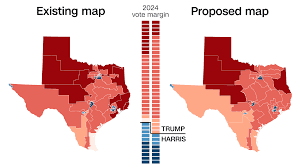
California and Texas politicians are pushing for more gerrymandering. California’s congressional districts were drawn by independent committee. Their governor called the Trump White House fascists as recently as today. There’s a vote to get five more D-districts. The claim is it’s to balance Texas’s push for three more R-districts. I nothing illegal or immoral here, just old style politics, power grabs left and right, with incendiary language. The districts look bad, but I’ve seen worse. No need to call ‘fascist’ unless your next step is to impeach president Trump again, or your hope is another shooting.
The worst option, in my opinion is term limits. It’s promoted from both sides, and I consider it insane, except for party bosses. It actively prevents people from re-electing the politicians they like based on the objection that these people have been on the job long enough to feel at home and get things done. I consider term limits completely non-republican, non-democratic, a disease, “fair” only in that it hurts every citizen equally, benefitting only party bosses.
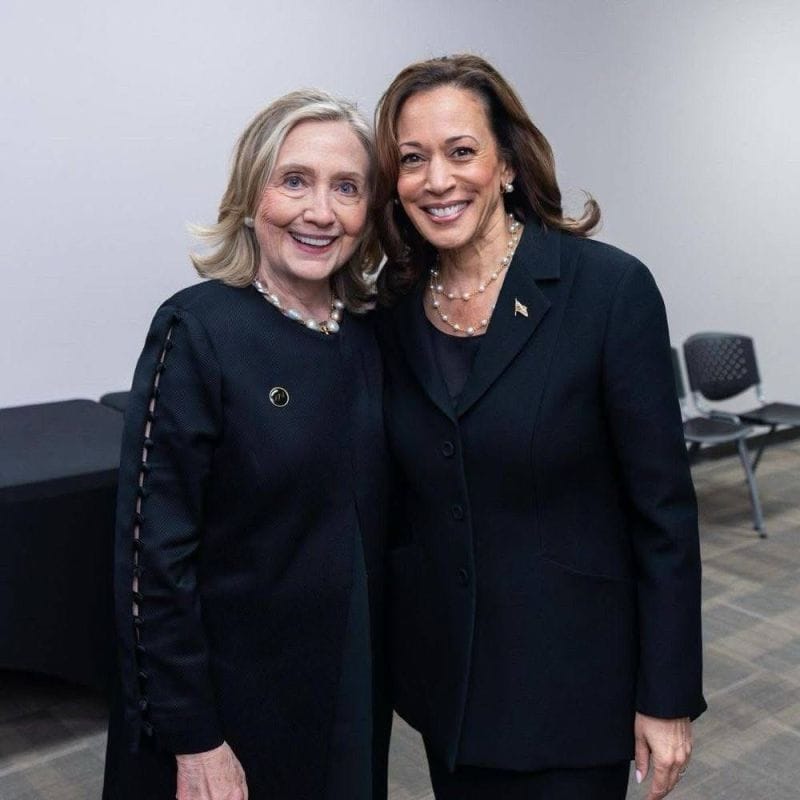
Kamala Harris always seems happy while most Democrats come off as sad, and report being sad. Harris’s campaign also stood out from Clinton’s and Biden’s for positivity. She never played the racism card, or the feminine glass ceiling card, and still managed to raise $1.5 B, some three times more money than any other candidate in history. In a campaign of only 108 days, she focussed on the swing states, inspiring support from the press, comedians, academia, Socialist Bernie Sanders, and the billionaire class: Mark Zuckerberg, Bill Gates, Jeff Bezos, etc. Quite a mix. She lead in the polls to the end, barely beaten by a seasoned, media-savvy Trump, running effectively as an incumbent. I suspect she’ll be unbeatable in 2028, if she’s allowed to run.
Harris has some minor down-sides, all of them related to her positivity. First off, Harris comes across as somewhat dim-witted. That’s annoying to political junkies, but not really a problem for most Americans. She comes across as having a good heart, and that’s enough. We elected George W. Bush and Joe Biden, dim-witted, likable guys, who people we related to. Brains can even be a handicap: we voted out George H. W. Bush, despite his brains and expertise, even after he’d taken down the Berlin Wall. It helps to have competent helpers, and Kamala stayed close to Obama and Cheney. Her VP failed to impress, but she’s sure to pick better in 2028.
Harris also comes off as drunk; she giggles a lot (AOC too). It makes them seem young and insubstantial. I find it annoying, but not deadly. It’s a way around tough questions, Rather like Regan’s jokes, or Trump repetitions. Hilary campaigned as a good, heavy smart and mean. Her “basket of deplorables” comments, for example. They must have sounded OK for those already on her side, but they sound mean and dismissive to everyone else. Harris will need a signature issue by 2028, but is sure to find one. Free everything seems to be working for Mamdani in NY.
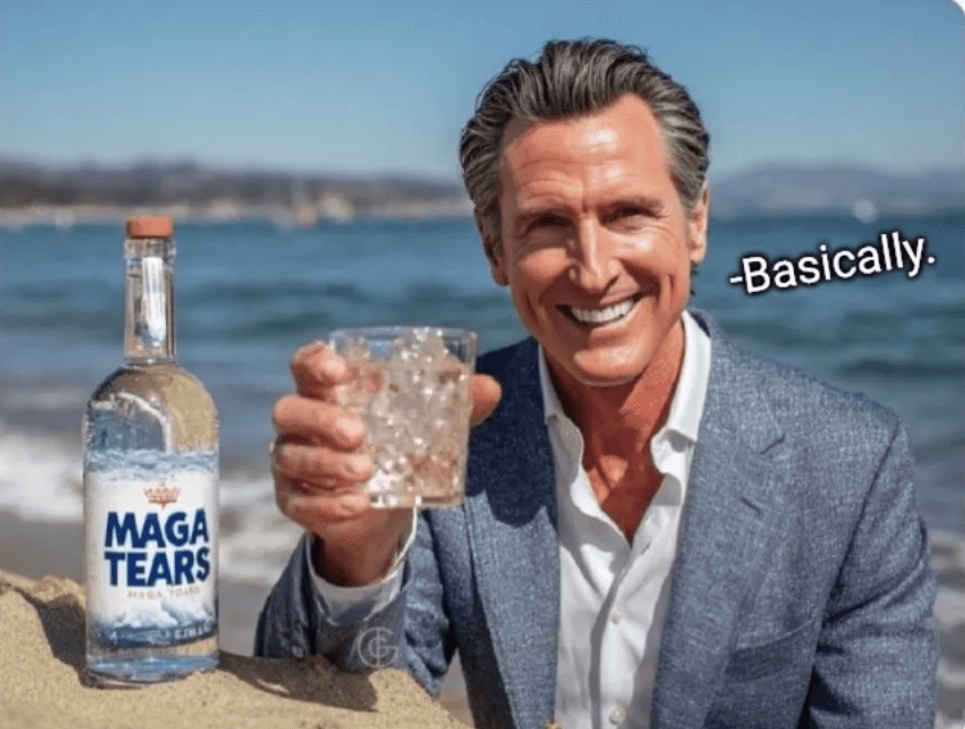
None of the other top D contenders for 2028 are anywhere near as likable as Harris. Gavin Newsom comes across as smart, but mean. Not too smart, but as mean as Hillary. His current push is to redistrict California to fight the Republicans. That’s smart but not inspiring; people of California will loose their representatives so the democrats can gain power. Then there are the photos he puts out of himself drinking “MAGA tears.” The idea he’s pushing is that Republicans are cry-babies, while he’s a man’s man, and that he enjoys making MAGA folks cry. It’s dismissive of the suffering (real and imagined) of the rural, less rich, less educated, white folks — the folks who are the core Republicans. He also calls them “The base,” and that’s another slight; they’re people, often hard working, disrespected, with uncertain job prospects, from communities that are unusually hit by prescription drug addiction. Harris knows enough to care or pretend to care.
A staple of Newsom’s campaign, him smiling, drinking “MAGA tears”
I don’t see Newsom as particularly manly, either. He looks less virile than Vance, who he targets as a compete wimp. Newsom recently published pictures with Vance’s head photoshopped onto a skinny female dancer. Is that funny? Is it true? Vance is an ex- marine. That’s the sort of manliness credential that Newsom doesn’t have, and is rare among Democrats. Not that I see America preferring manly men, but Newsom should know enough to not to get into a manliness fight with a marine.
And that brings us to baggage. Harris has relatively little. Newsom has the California fires that he screwed up by diverting water. He has ownership protecting high crime, the homelessness by fighting ICE and The national guard. He also has the baggage of California’s, high taxes, high regulations, high energy costs, and population flight. California keeps needing to borrow money, and in this, I doubt it helps that he’s made illegal immigrants a priority. He could acknowledge that Trump has reduced crime, as the DC mayor has. Harris has mostly avoided speaking on these issues, and it seems to help.
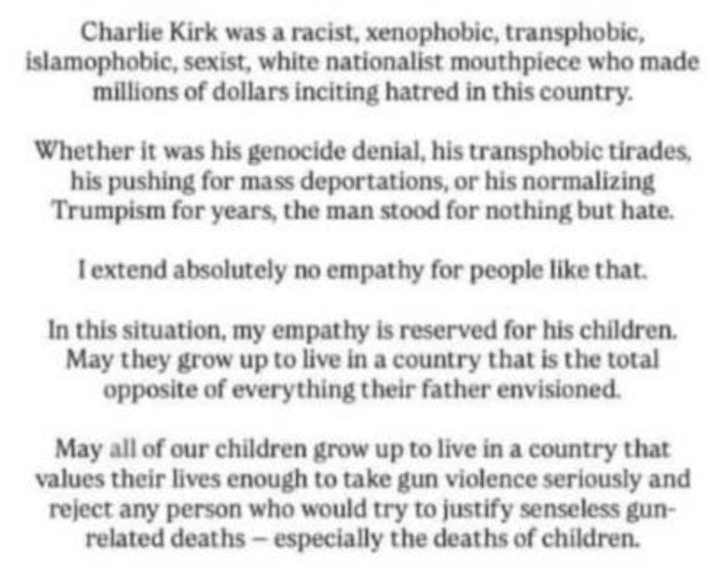
No empathy for Charlie Kirk from Manitoba’s Minister of Families
Other Democrat heavyweights are as bad. Walz says he checks his phone every day hoping to see that Trump is dead. He also claimed to enjoy news that Tesla stock is down. Illinois Governor Pritzker, here, blamed Trumps heated rhetoric for the murder of Charlie Kirk. Then there are those like the MSNBC host or CNN’s who blamed Kirk himself. Or this, from Manitoba’s Minister of Families. It’s mean, untrue, and not even self serving. Harris comes off as the best among the Ds, and the most electable.
Robert Buxbaum, September 12, 2025. I’m a New Yorker, and I like Trump’s accent, his brashness, his tariffs and peace initiatives — and that he backs Israel over Palestine. A lot of people can’t stand him though. Folks are likely to elect a Democrat in 2028 — so long as the D candidate doesn’t claim to drink MAGA tears or watch to see Republicans dead.
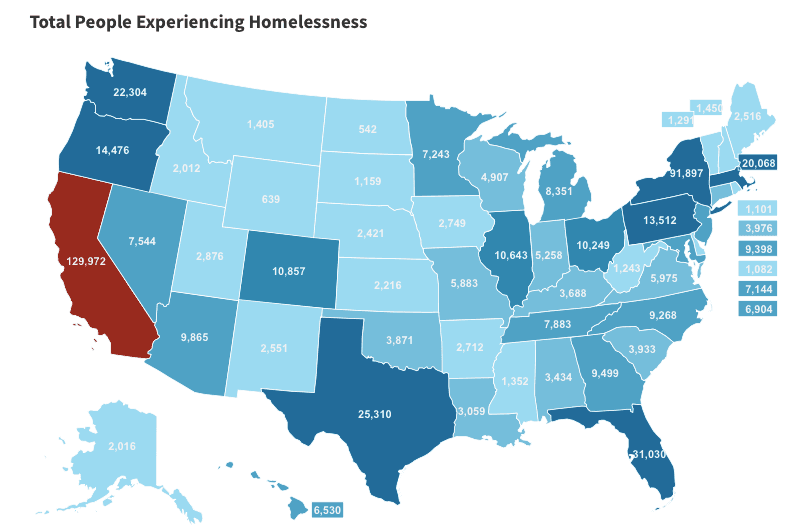
California likely leads the nation in socially activist government kindness. It also leads the nation in homelessness, chronic homelessness, and homeless veterans. The US Council on Homelessnesses estimates that, on any given day, 129,972 Californians are homeless, including 6,702 family households, and 10,836 veterans; 34,332 people are listed among “the chronic homeless”. That is, Californians with a disability who have been continuously homeless for one year or cumulatively homeless for 12 months in the past three years. No other state comes close to these numbers. The vast majority of these homeless are in the richer areas of two rich California cities: Los Angeles and San Francisco (mostly Los Angeles). Along with the homeless in these cities, there’s been a rise in 3rd world diseases: cholera, typhoid, typhus, etc. I’d like to explore the relationship between the policies of these cities and the rise of homelessness and disease. And I’d like to suggest a few cures, mostly involving sanitation.
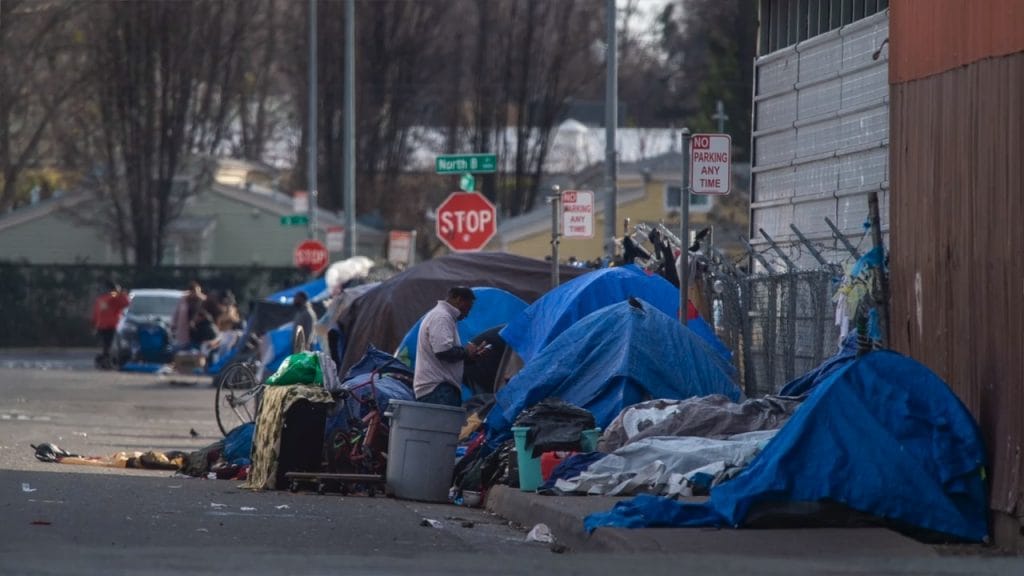
A homeless encampment in LosAngeles
Most of the US homeless do not live in camps or on the streets. The better off US homelessness find it is a temporary situation. They survive living in hotels or homeless shelters, or they “couch-serf,” with family or friends. They tend to take part time jobs, or collect unemployment, and they eventually find a permanent residence. For the chronic homeless things are a lot grimmer, especially in California. The chronic unemployed do not get unemployment insurance, and California’s work rules tend to mean there are no part time jobs, and there is not even a viable can and bottle return system in California, so the homeless are denied even this source of income*. There is welfare and SSI, but you have to be somewhat stable to sign up and collect. The result is that California’s chronic homeless tend to live in squalor strewn tent cities, supported by food handouts.
Californians provide generous food handouts, but there is inadequate sewage, or trash collection, and limited access to clean water. Many of the chronic homeless are drug-dependent or mentally ill, and though they might benefit from religion-based missions, Los Angeles has pushed the missions to the edges of the cities, away from the homeless. The excess food and lack of trash collection tends to breed rats and disease, and as in the middle ages, the rats help spread the diseases.
Total homelessness by state, 2018; California leads the nation. The better off among these individuals do not live on the streets, but in hotels or homeless shelters. For most, this is a short term situation. The rest, about 20%, are chronically homeless. About half of these live on the streets without adequate sewage and water. Many are drug-dependent.
The first major outbreaks of the homeless camps appeared in Los Angeles in August and September of 2017. They reappeared in 2018, and by late summer, rates were roughly double 2017’s. This year, 2019, looks like it could be a real disaster. The first case of a typhoid infected police officer showed up in May. By June there were six police officers with typhoid, and that suggests record numbers are brewing among the homeless.
To see why sanitation is an important part of the cure, it’s worth noting that typhoid is a disease of unclean hands, and a relative of botulism. It is spread by people who go to the bathroom and then handle food without washing their hands first. The homeless camps do not, by and large, have hand washing stations. and forced hygiene is prohibited. Los Angeles has set up porta-potties, with no easy hand washing. The result is typhoid epidemic that’s even affecting the police (six policemen in June!).
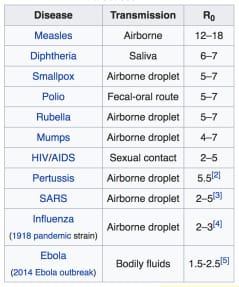
R-naught, reproduction number for some diseases, CDC.
Historically, the worst outbreaks of typhoid were spread by food workers. This was the case with “typhoid Mary of the early 20th century.” My guess is that some of the police who got typhoid, got it while trying to feed the needy. If so, this fellow could become another Typhoid Mary. Ideally, you’d want shelters and washing stations where the homeless are. You’d also want to pickup the dirtier among the homeless for forced washing and an occasional night in a homeless shelter. This is considered inhumane in Los Angeles, but they do things like this in New York, or they did.
Typhus is another major disease of the California homeless camps. It is related to typhoid but spread by rodents and their fleas. Infected rodents are attracted to the homeless camps by the excess food. When the rodents die, their infected fleas jump to the nearest warm body. Sometimes that’s a person, sometimes another animal. In a nastier city, like New York, the police come by and take away old food, dead animals, and dirty clothing; in Los Angeles they don’t. They believe the homeless have significant squatters rights. California’s kindness here results in typhus.
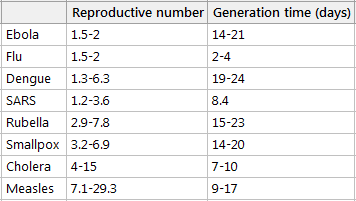
Reproduction number and generation time for some diseases.
The last of the major diseases of the homeless camps is cholera. It’s different from the others in that it is not dependent on squalor, just poor health. Cholera is an airborne disease, spread by coughing and sneezing. In California’s camps, the crazy and sick dwell close to each other and close to healthy tourists. Cholera outbreaks are a predictable result. And they can easily spread beyond the camps to your home town, and if that happens a national plague could spread really fast.
I’d discussed R-naught as a measure of contagiousness some months ago, comparing it to the reproductive number of an atom bomb design, but there is more to understanding a disease outbreak. R-naught refers merely to the number of people that each infected person will infect before getting cured or dying. An R-naught greater than one means the disease will spread, but to understand the rate of spread you also need the generation time. That’s the average time between when the host becomes infected, and when he or she infects others. The chart above shows that, for cholera, r-naught is about 10, and the latency period is short, about 9 days. Without a serious change in California’s treatment of the homeless, each cholera case in June will result in over 100 cases in July, and well over 10,000 in August. Cholera is somewhat contained in the camps, but once an outbreak leaves the camps, we could have a pandemic. Cholera is currently 80% curable by antibiotics, so a pandemic would be deadly.
Hygiene is the normal way to prevent all these outbreaks. To stop typhoid, make bathrooms available, with washing stations, and temporary shelters, ideally these should be run by the religious groups: the Salvation Army, the Catholic Church, “Loaves and Fishes”, etc. To prevent typhus, clean the encampments on a regular basis, removing food, clothing, feces and moving squatters. For cholera, provide healthcare and temporary shelters where people will get clean water, clean food, and a bed. Allow the homeless to work at menial jobs by relaxing worker hiring and pay requirements. A high minimum wage is a killer that nearly destroyed Detroit. Allow a business to hire the homeless to sweep the street for $2/hour or for a sandwich, but make a condition that they wash their hands, and throw out the leftovers. I suspect that a lot of the problems of Puerto Rico are caused by a too-high minimum wage by the way. There will always be poor among you, says the Bible, but there doesn’t have to be typhoid among the poor, says Dr. Robert Buxbaum.
July 30, 2019. I ran for water commissioner in Oakland county, Michigan, 2016. If there is interest, I’ll run again. One of my big issues is clean water. Oakland could use some help in this regard.
As of this month, the District of Columbia has joined 15 states in a pact to would end the electoral college choice of president. These 15 include New York, California, and a growing list of solid-blue (Democratic party) states. They claim the electoral must go as it robed them of the presidency perhaps five times: 2016, 2000, 1888, 1876, and perhaps 1824. They would like to replace the electoral college by plurality of popular vote, as in Mexico and much of South America.
All the big blue states and some small blue states have joined a compact to end the electoral college. As of 2019, they are 70% of the way to achieving this.
As it happens, I had to speak on this topic in High School in New York. I for the merits of the old system beyond the obvious: that it’s historical and works. One merit I found, somewhat historical, is that It was part of a great compromise that allowed the US to form. Smaller states would not have joined the union without it, fearing that the federal government would ignore or plunder them without it. Remove the vote advantage that the electoral college provides them, and the small states might have the right to leave. Federal abuse of the rural provinces is seen, in my opinion in Canada, where the large liberal provinces of Ontario and Quebec plunder and ignore the prairie provinces of oil and mineral wealth.
Several of the founding federalists (Jay, Hamilton, Washington, Madison) noted that this sort of federal republic election might bind “the people” to the president more tightly than a plurality election. The voter, it was noted, might never meet the president nor visit Washington, nor even know all the issues, but he could was represented by an elector who he trusted, he would have more faith in the result. Locals would certainly know who the elector favored, but they would accept a change if he could justify it because of some new information or circumstance, if a candidate died, for example, or if the country was otherwise deadlocked, as in 1800 or 1824.
Historically speaking, most electors vote their states and with their previously stated (or sworn) declaration, but sometimes they switch. In, 2016 ten electors switched from their state’s choice. Sven were Democrats who voted against Hillary Clinton, and three were Republicans. Electors who do this are called either “faithless electors” or “Hamilton electors,” depending on whether they voted for you or against you. Hamilton had argued for electors who would “vote their conscience” in Federalist PaperNo. 68. One might say these electors threw away their shot, as Hamilton did not. Still, they showed that elector voting is not just symbolic.
Federalist theory aside, it seems to me that the current system empowers both large and small states inordinately, and swing states, while disempowering Alabama and Massachussetts. Change the system and might change the outcome in unexpected ways.
That the current system favors Rhode Island is obvious. RI has barely enough population for 1 congressman, and gets three electors. Alabama, with 7 congressmen, gets 9 electors. Rhode Islanders thus get 2.4 times the vote power of Alabamans.
It’s less obvious that Alabama and Massachussetts are disfavored compared to New Yorkers and Californians. But Alabama is solid red, while New York and California are only sort of blue. They are majority Democrat, with enough Republicans to have had Republican governors occasionally in recent history. Because the electoral college awards all of New York’s votes to the winner, a small number Democrat advantage controls many electors.
In 2016, of those who voted for major party candidates in New York, 53% voted for the Democrat, and 47% Republican. This slight difference, 6%, swung all of NY’s 27 electors to Ms Clinton. If a popular vote are to replace the electoral college, New York would only have the net effect of the 6% difference; that’s about 1 million net votes. By contrast, Alabama is about 1/3 the population of New York, but 75% Republican. Currently its impact is only 1/3 of New York’s despite having a net of 2.5 million more R voters. Without the college, Alabama would have 2.5 times the impact of NY. This impact might be balanced by Massachusetts, but at the very least candidates would campaign in these states– states that are currently ignored. Given how red and blue these states are, it is quite possible that the Republican will be more conservative than current, and the Democrat more liberal, and third party candidates would have a field day as is common in Mexico and South America.
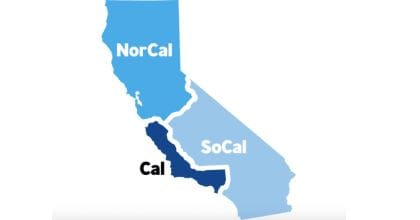
Proposed division of California into three states, all Democrat-leaning. Supposedly this will increase the voting power of the state by providing 4 more electors and 4 more senators.
California has petitioned for a different change to the electoral system — one that should empower the Democrats and Californians, or so the theory goes. On the ballot in 2016 was bill that would divide California into three sub-states. Between them, California would have six senators and four more electors. The proposer of the bill claims that he engineered the division, shown at right, so skillful that all three parts would stay Democrat controlled. Some people are worried, though. California is not totally blue. Once you split the state, there is more than three times the chance that one sub-state will go red. If so, the state’s effect would be reduced by 2/3 in a close election. At the last moment of 2016 the resolution was removed from the ballot.
Turning now to voter turnout, it seems to me that a change in the electoral college would change this as well. Currently, about half of all voters stay home, perhaps because their state’s effect on the presidential choice is fore-ordained. Also, a lot of fringe candidates don’t try as they don’t see themselves winning 50+% of the electoral college. If you change how we elect the president we are sure find a new assortment of voters and a much wider assortment of candidates at the final gate, as in Mexico. Democrats seem to believe that more Democrats will show up, and that they’ll vote mainstream D, but I suspect otherwise. I can not even claim the alternatives will be more fair.
In terms of fairness, Marie de Condorcet showed that the plurality system will not be fair if there are more than two candidates. It will be more interesting though. If changes to the electoral college system comes up in your state, be sure to tell your congressperson what you think.